By: Greg McKinney Mineola TX
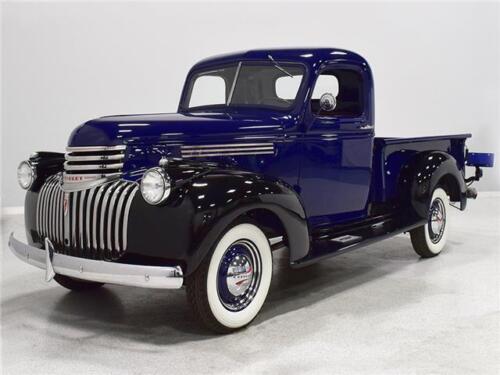
The Chevrolet trucks we see today have a history that is worth knowing because how they evolved with time and became what they are today is a really moving anecdote. The 1940’s was essentially an important decade for the whole of mankind because it saw both the war and post-war worlds, but how it affected and changed the automotive segment is reflected in the Chevrolet Pickups of the 1940’s. The country was emerging from the Great Depression at the time, and the demand for small vehicles was rising. Somehow, all this makes the Chevrolet trucks of this decade more interesting.
Mise-en-scène
The 1940s saw Chevrolet remain on its path of building dedicated pickup trucks that were not based on its passengers’ cars. The Chevrolet Master Truck series ushered Chevrolet into this new territory of pickup trucks, and in 1941 its successor, the AK Series, was introduced. It saw production until 1947, after which it was replaced with the Advance-Design series, which was produced from 1947 to 1955 and was truly an advance design.
Now that we have a bit of background on that decade, let’s dive into what makes these trucks special and worthy.
Peculiarities
Moving to an independent platform for its pickup trucks gave Chevrolet more freedom to optimize its trucks for usability as well as adaptability. They featured a sturdy and well-built frame and body, which made them suitable for heavy-duty work and towing.
These trucks also introduced a new design with an improved cab and cargo box, and were available in a variety of body styles and configurations. The cab was also larger and more comfortable than the previous models. Some Chevy truck fans believe that the 1940 model had the best cab design.
Heart of an Inline-Six
The Chevrolet “Stovebolt” engine, a term commonly used to refer to Chevrolet’s inline-six engines produced between 1929 and 1954, powered these trucks. These engines were known for their durability, reliability, fuel efficiency, and low-end torque, and were used in a wide range of Chevrolet vehicles, including trucks, cars, and even marine and industrial applications.
The Stovebolt engines used in these trucks were 216 cu in in displacement and 288 cu in for the GMC versions. The engines were paired with a 3-speed manual gearbox and had drum brakes on all four wheels.
Model Range
In 1940, Chevy offered pickup truck models ranging from the ½ ton to the 1 ½ ton. The wheelbase of the half-ton truck was 113.5 inches, whereas the wheelbase of the ¾ ton truck was 123.75 inches. The typical heavy-duty 1 ½ ton Chevy truck had a wheelbase of 133.0 inches. The 1941 Chevy Half Ton had a longer wheelbase of 115.0 inches. The 1941 model seemed substantially larger than the 1940 model due to the wider wheelbase and considerable front end design revisions.
The Headlight Innovation
The 1940 Chevrolet Half-Ton was the first vehicle to have sealed-beam headlights. A sealed beam headlamp is one that combines the lens, filament, and reflector into a single unit. The first such headlights were installed in 1939, and they were required from 1940 until 1984.
Closing Words
The Chevrolet trucks marked a turning point in how a pickup truck is made. This was such a success that every American-made truck is now built on its own ladder-frame platform or one shared with other utility vehicles, rather than on a passenger vehicle platform. Even though unibody trucks (based on passenger cars) like the Honda Ridgeline and Hyundai Santa Cruz are making an appearance, conventional trucks are proven and are here to stay thanks to their versatility.
 Classic Chevrolet Trucks